
WhatsApp
Hi there 👋
Request Free Estimate

Our experts can help you!
constructionestimatehelp.au@gmail.com
+1 (240) 8399485

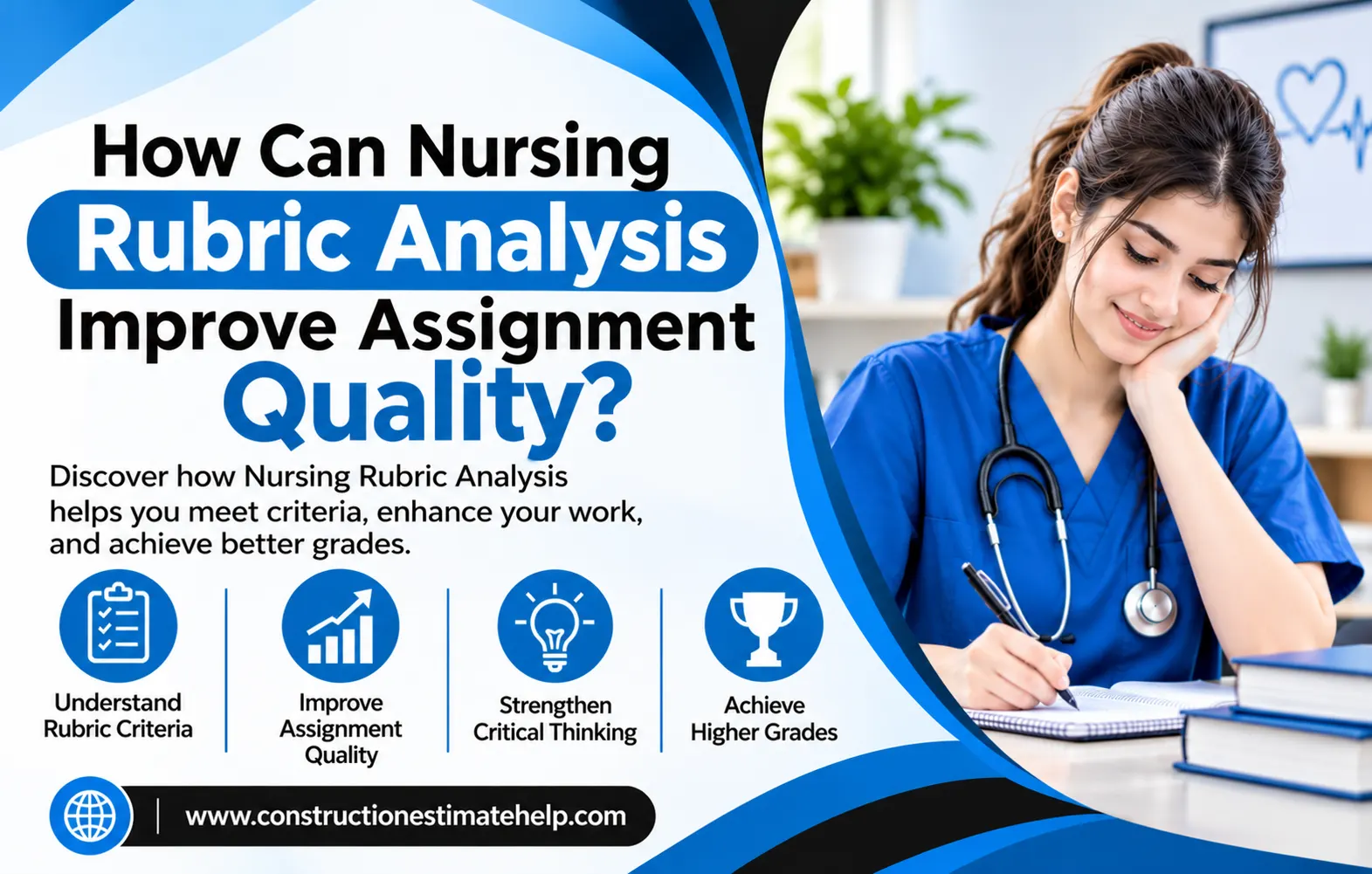
How Can Nursing Rubric Analysis Improve Assignment Quality?

Completing a nursing assignment requires more than subject knowledge and research skills. Students must understand assessment expectations, follow academic guidelines, organize information, and present accurate answers. This is where nursing rubric analysis becomes valuable. It helps students understand how their work will be evaluated and identify the key elements required to achieve better academic results.

A well-structured rubric provides clear assessment criteria, including research quality, critical thinking, referencing, writing style, and practical application. By reviewing these requirements before starting an assignment, students can improve accuracy, save time, and avoid common academic mistakes.

What Is Nursing Rubric Analysis?

Nursing rubric analysis is the process of reviewing and understanding assessment criteria before completing a nursing assignment. It explains what instructors expect from students and how different sections contribute to the final grade.

For example, a nursing assessment rubric may evaluate:

  • Understanding of nursing concepts and theories.

  • Evidence-based research and clinical knowledge.

  • Critical thinking and problem-solving skills.

  • Proper referencing and academic formatting.

  • Clarity, organization, and presentation.

Understanding these points helps students prepare assignments that meet academic expectations.

How Does Nursing Rubric Analysis Improve Assignment Quality?

1. Provides Clear Assessment Expectations

Rubric analysis helps students understand exactly what their instructors expect. Instead of guessing which topics require attention, students can focus on the specific assessment criteria.

It also helps identify important instructions, word limits, marking categories, and required academic evidence.

2. Improves Research and Critical Thinking

Nursing assignments often require evidence-based arguments and practical examples. Reviewing the marking criteria encourages students to use reliable academic sources, research relevant healthcare topics, and develop meaningful explanations.

Students can also connect nursing theories with real-world patient care situations.

3. Helps Improve Academic Structure

A detailed rubric makes it easier to organize an assignment into logical sections. Students can create appropriate headings, arrange supporting arguments, and ensure that every assessment requirement is addressed.

Using a nursing assignment marking rubric guide can make this preparation process more effective, particularly for complex case studies and research-based coursework.

4. Reduces Common Assignment Mistakes

Many students lose marks because they overlook instructions, provide insufficient evidence, or use incorrect referencing styles.

Rubric analysis helps prevent these problems by providing a checklist for reviewing the completed assignment before submission.

Read More: Why Is Nursing Assessment Guidance Important for Nursing Students?

Can Rubric Analysis Help With Other Academic Subjects?

Yes. Understanding assessment criteria is useful across multiple academic disciplines, not just nursing.

For example, students working on literature assignments may need structured guidance through cathedral raymond carver analysis Assignment Help. Similarly, learners handling financial concepts and economic theories may benefit from Economics Analysis Assignment Help.

The same principle applies to technical subjects. Construction-related academic projects may require accurate calculations, budgeting knowledge, and industry research. Professional construction estimating services can help students understand estimating concepts, while Construction Estimation Sydney provides a location-focused reference for exploring construction estimation practices in Sydney, Australia.

These examples demonstrate how structured assessment preparation can support better learning across different subjects.

How Can Students Use a Nursing Rubric Effectively?

Students can follow these practical steps:

  1. Read the complete rubric: Understand every assessment category before beginning.

  2. Identify marking priorities: Focus on criteria carrying higher marks.

  3. Prepare an assignment outline: Match headings with the assessment requirements.

  4. Use reliable research: Support arguments with relevant academic evidence.

  5. Review the final draft: Check formatting, referencing, clarity, and completeness.

  6. Compare against the rubric: Ensure that every requirement has been addressed.

Why Is Professional Academic Guidance Helpful?

Academic guidance can help students understand complicated assignment instructions, organize research, and improve presentation. ConstructionEstimateHelp promotes structured approaches to technical and academic project preparation.

Whether students are exploring nursing assessment requirements or construction-related topics in Sydney, understanding evaluation criteria can help them develop more organized and informative work.

Frequently Asked Questions (FAQs)

Q1. What is nursing rubric analysis?

It is the process of understanding nursing assignment assessment criteria to identify expectations and improve academic performance.

Q2. Why is a nursing assignment marking rubric guide important?

It helps students understand grading requirements, organize their assignments, and identify areas that need improvement.

Q3. Can rubric analysis improve nursing assignment grades?

Yes. It helps students address assessment requirements, strengthen research, and avoid mistakes that may affect their marks.

Q4. How early should students review an assignment rubric?

Students should review the rubric before starting their assignments to plan research, structure, and content effectively.

Q5. Is rubric analysis useful for construction assignments?

Yes. It helps students understand project requirements, technical expectations, calculations, and assessment standards.

Nursing Study Consultation for Smarter Academic Decisions

Nursing students must balance theoretical knowledge, clinical learning, research projects, and academic deadlines. Managing these responsibilities can become challenging, especially when assignments require evidence-based arguments, proper referencing, and critical analysis. A nursing study consultation helps students understand academic expectations, improve their study strategies, and make informed decisions throughout their education.

Whether you are studying in Australia, the UK, the USA, or another country, the right academic guidance can help you approach complex nursing subjects with greater confidence. From understanding a nursing assignment structure to developing research skills, students can benefit from practical advice that supports independent learning and academic progress.

What Is Nursing Study Consultation?

Nursing study consultation is an educational support process that helps students understand coursework requirements, research methods, academic writing, and assignment expectations. It focuses on identifying learning gaps and developing practical strategies for completing academic tasks effectively.

Students can seek guidance when preparing case studies, care plans, reflective journals, research proposals, and evidence-based nursing reports. For example, a student writing about patient safety may need help identifying credible research, organising arguments, and connecting nursing theories with clinical practice.

Why Is Nursing Assignment Structure Important?

A clear nursing assignment structure helps students present information logically and address assessment criteria effectively. It allows readers to follow the discussion from the introduction to the conclusion without confusion.

Key Elements of a Nursing Assignment

A well-organised nursing assignment generally includes:

  • Introduction: Introduce the topic, explain its significance, and outline the main discussion.
  • Main body: Present evidence, explain nursing concepts, and critically analyse relevant information.
  • Evidence and referencing: Support claims with credible academic sources and follow the required referencing style.
  • Conclusion: Summarise the main findings without introducing unrelated arguments.
  • Reference list: Include the sources cited in the assignment using the prescribed format.

Always check your university’s assessment rubric because requirements may differ between nursing programmes and assignment types.

How Does Nursing Research Guidance Improve Academic Performance?

Nursing research guidance helps students understand how to find, evaluate, and apply reliable evidence to academic questions. Research skills are particularly important when assignments involve patient care, public health, clinical decision-making, or healthcare policies.

Practical Steps for Better Nursing Research

Start by turning your assignment topic into a focused research question. Search academic databases such as PubMed and CINAHL for relevant studies. Evaluate publication dates, research methods, sample sizes, and the credibility of the findings before using them.

For instance, a student researching infection prevention can compare recent clinical studies and recognised healthcare guidelines to understand effective practices.

Students should also distinguish between primary research, systematic reviews, and general online information. This approach encourages evidence-based reasoning and strengthens academic arguments.

What Are the Benefits of Nursing Academic Writing Support?

Nursing academic writing support helps students improve clarity, organisation, critical thinking, and academic presentation. It can be particularly useful for students who struggle with complex terminology, referencing rules, or research-based discussions.

Common benefits include:

  • Better understanding of assignment instructions.
  • Improved paragraph organisation and argument development.
  • More effective use of scholarly evidence.
  • Greater confidence with academic referencing.
  • Stronger proofreading and editing habits.
  • Improved time management during busy semesters.

The purpose of academic support should be to develop independent skills. Students should follow institutional academic integrity policies and ensure submitted work reflects their own understanding.

Read More: Packaging Design Assignment Help: Expert Tips for Better Grades

Where Can Nursing Students Find Study Consultation?

Students in Melbourne, Sydney, Brisbane, London, and other university cities can explore academic learning centres, university writing services, library research workshops, and subject-specific tutoring.

Online consultations can also help students who need flexible scheduling or remote access to learning resources. Before choosing a provider, review its subject expertise, service details, privacy practices, and academic integrity standards.

ConstructionEstimateHelp should ensure that any nursing-related educational service it promotes is clearly described and supported by appropriate subject expertise.

Frequently Asked Questions

1. How can nursing students organise assignments effectively?

Review the marking rubric, create an outline, divide the task into manageable sections, and allocate time for research, writing, referencing, and proofreading.

2. Where can students find reliable nursing research?

PubMed, CINAHL, university library databases, peer-reviewed journals, and recognised healthcare organisations are useful starting points.

3. Is nursing academic writing support useful for beginners?

Yes. Beginners can learn academic structure, referencing techniques, evidence evaluation, and critical analysis through feedback and guided practice.

4. Can online nursing study consultation help busy students?

Yes. Online consultations can provide flexible access to academic guidance, helping students plan their workload around classes, placements, and other responsibilities.

Conclusion

Nursing study consultation can help students make smarter academic decisions by improving assignment planning, research skills, and academic writing. With a clear structure, credible evidence, and consistent practice, nursing students can build confidence and strengthen their academic performance while preparing for future healthcare responsibilities.