
WhatsApp
Hi there 👋
Request Free Estimate

Our experts can help you!
constructionestimatehelp.au@gmail.com
+1 (240) 8399485

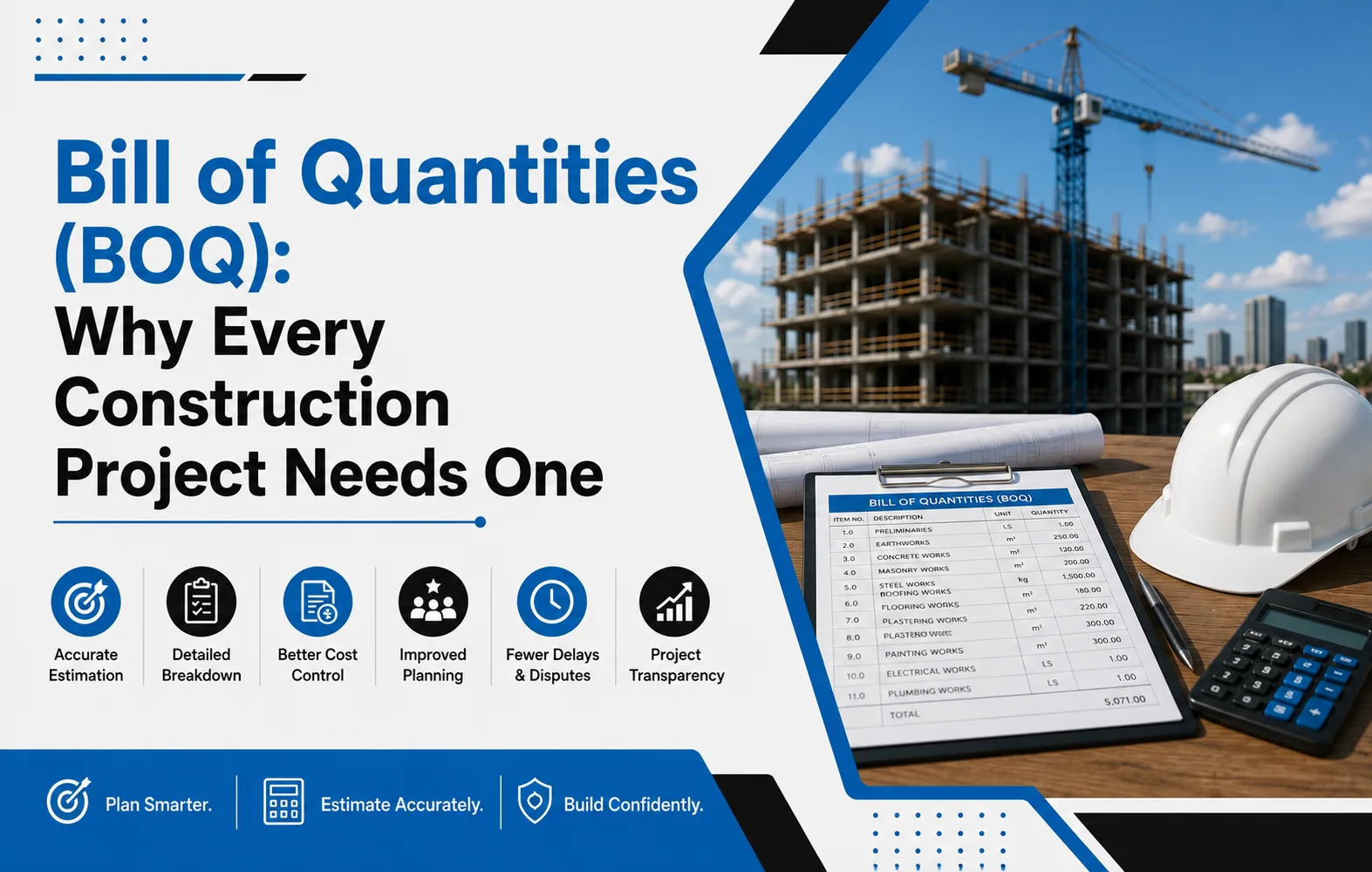
Bill of Quantities (BOQ): Why Every Construction Project Needs One

Every successful construction project starts with proper planning, accurate budgeting, and detailed documentation. One of the most important documents in this process is the Bill of Quantities (BOQ). Whether you’re building a residential property, commercial complex, or industrial facility, a well-prepared Bill of Quantities in Construction helps keep your project organised, cost-effective, and on schedule.

At Construction Estimate Help, we provide reliable Construction Cost Estimating Services and detailed BOQs that help contractors, builders, developers, and architects make informed decisions from project start to finish.

What Is a Bill of Quantities (BOQ)?

A Bill of Quantities (BOQ) is a comprehensive document that lists all materials, labour, equipment, and work required to complete a construction project. It includes item descriptions, quantities, units of measurement, and estimated costs.

The primary purpose of a Construction Bill of Quantities is to provide a clear understanding of project requirements, making it easier to prepare accurate bids, compare contractor quotations, and control overall construction costs.

Why Is a BOQ Important for Construction Projects?

A detailed BOQ for Construction Projects offers several benefits that improve project efficiency and reduce financial risks.

1. Accurate Cost Planning

A BOQ breaks down every construction activity into measurable quantities. This allows project owners to estimate costs accurately and avoid unexpected expenses during construction.

2. Simplifies Contractor Bidding

When all contractors receive the same Bill of Quantities in Construction, they can prepare quotations using identical project information. This creates fair competition and makes bid comparisons much easier.

3. Better Budget Control

A detailed BOQ helps track project spending throughout construction. It identifies cost variations early, allowing project managers to stay within budget.

4. Reduces Material Waste

Knowing the exact quantity of materials required helps minimise over-ordering and shortages. This leads to better inventory management and reduced project waste.

5. Improves Project Transparency

A well-prepared Construction Bill of Quantities clearly defines the scope of work, reducing misunderstandings between clients, contractors, and suppliers.

What Does a Bill of Quantities Include?

A professional BOQ typically contains:

  • Project information
  • Detailed work descriptions
  • Material quantities
  • Labour requirements
  • Unit measurements
  • Pricing estimates
  • Total project costs
  • Notes and specifications

These details make the document an essential reference throughout the construction process.

How Construction Estimate Help Supports Your Projects

At Construction Estimate Help, our experienced estimators prepare accurate BOQ for Construction Projects tailored to your drawings and specifications.

Our Construction Cost Estimating Services help clients:

  • Prepare competitive bids
  • Improve budgeting accuracy
  • Reduce project risks
  • Save time during tender preparation
  • Manage project costs efficiently

Whether you’re a contractor working on multiple projects or a developer planning a new build, our team delivers dependable construction estimating services with fast turnaround times and exceptional accuracy.

Who Needs a Bill of Quantities?

A BOQ is valuable for nearly everyone involved in construction, including:

  • General contractors
  • Subcontractors
  • Property developers
  • Architects
  • Engineers
  • Quantity surveyors
  • Project managers
  • Government agencies

Using a professionally prepared Construction Bill of Quantities helps all stakeholders make informed decisions throughout the project lifecycle.

A Bill of Quantities (BOQ) is much more than a pricing document. It serves as the foundation for accurate budgeting, transparent bidding, cost control, and efficient project management. Investing in a professionally prepared Bill of Quantities in Construction can significantly reduce financial risks and improve project success.

If you’re looking for dependable Construction Cost Estimating Services, trust Construction Estimate Help. Our experienced estimators provide detailed BOQ for Construction Projects and reliable construction estimating services that help you build with confidence.

Frequently Asked Questions (FAQs)

1. What is a Bill of Quantities (BOQ)?

A Bill of Quantities (BOQ) is a detailed document listing all materials, labour, equipment, and quantities required for a construction project, along with estimated costs.

2. Why is a BOQ important in construction?

It improves budgeting accuracy, simplifies contractor bidding, controls project costs, reduces material waste, and ensures transparency throughout the project.

3. Who prepares a Construction Bill of Quantities?

A BOQ is typically prepared by professional quantity surveyors or experienced estimators offering Construction Cost Estimating Services.

4. Can Construction Estimate Help prepare BOQs for residential and commercial projects?

Yes. Construction Estimate Help provides accurate Construction Bill of Quantities and construction estimating services for residential, commercial, industrial, and infrastructure projects.

5. How does a BOQ help reduce construction costs?

By accurately calculating material quantities and labour requirements, a BOQ minimises errors, prevents over-ordering, and helps maintain better budget control throughout the project.

Bid Analysis: Meaning, Process, Types, and Evaluation Criteria

As you know, we work within a competitive procurement and construction industry where Bid Analysis is one of the vital functions to select a suitable contractor, supplier or service provider. Regardless of what the specific field of working might be, such as Virtual Bid Management, construction estimating and bidding, procurement activities and others, the more informed we are about bid analysis, the more effective are our decisions, lower the cost and higher the project success.

Meaning of Bid Analysis

The definition of Bid Analysis is “the process of evaluating submitted proposals from vendors, contractors or suppliers to an open tender or RFP (Request for Proposal).” We must remember here that “best” value is not just the lowest price, but best value including consideration for cost, quality, capability, conformance and other project constraints and specifications.

In the case of Bid analysis in procurement, multiple factors should be analyzed for achieving efficiency in the expenditure and optimum resource allocation. The purpose of this is to avoid misleading evaluations.

How Does Bid Analysis Work?

Many people often ask “how does bid analysis work”. Generally, bid analysis involves receiving all proposals, reading the content and comparing different factors such as price structures, experience, qualifications of the bidder and others and finally selecting a suitable one based on multiple constraints and aspects.

It is important that a properly Structured Procurement bid assessment is performed. In other words, the process must be done systematically to make sure that one doesn’t make any faulty decision and to prevent the procurement risks arising from low qualified contractors. Accurate Construction estimating services are an essential component in the process to evaluate and compare submitted construction bids.

Bid Analysis Process

Here is the generally adopted Bid analysis process:

1. Bid Collection

All bids submitted are collected and systematically organized by the requirements specified in the tender.

2. Preliminary Screening

The irrelevant and invalid bids (late submissions, insufficient requirements, etc.) are rejected.

3. Technical Evaluation

Experience, expertise, capability and quality of the submitted proposal along with any methodology is assessed and evaluated.

4. Commercial Evaluation

Pricing structure, payment terms and finances of the submitted bid are reviewed.

5. Comparative Analysis

Comparison between all submitted bids to assess and analyze the strengths and weaknesses of each one.

6. Final Selection

A choice is made between all proposed bids based on best value, meeting project requirements etc.
Companies like Construction Estimate Help provide support to clients for Bid analysis.

Types of Bid Analysis

There are different types of bid analysis in a process and we need to decide which one is most appropriate for us.

  • Cost-Based Analysis- focuses on price
  • Technical Analysis- evaluates technical capability of a proposal
  • Financial Analysis- assesses financial strength and stability of the bid
  • Risk-Based Analysis- looks at risks in the delivery of a project
  • Value-Based Analysis- compares and contrasts multiple bids on a variety of criteria to assess overall value.

These are generally used in Tender bid analysis.

Bid Evaluation Criteria

When making the decision of evaluating proposals based on multiple aspects of a proposal; a specific set of Bid evaluation criteria is normally defined and followed. These could be:

  • Competitive pricing
  • Technical competence
  • Experience and past performance
  • Quality assurance procedures
  • Delivery schedule
  • Compliance to requirements
  • Financial stability
  • Safety record
  • Client references
  • Post-award service.

The selection of vendor through the process of Vendor bid evaluation.

Importance of Bid Analysis in Construction

Bid analysis is paramount for any construction project. As you might know, construction estimating and bidding is extremely important for all construction owners and contractors, whether or not using virtual bid management systems. This helps the owner to make informed decisions of who is the most suitable contractor, also providing them with valuable information as to whether a submitted construction bid is reasonable and cost-effective. Professional services, such as those of Construction Estimate Help, help clients by estimating construction costs, comparing sub-bids, and generally guiding them throughout the process.

Conclusion

Bid Analysis is undoubtedly a critical process in procurement and construction. Understanding its meaning, definition, various types and adopting appropriate bid evaluation criteria ensures optimum results are achieved at minimum cost while maintaining quality of the project. Bid Analysis whether through Virtual Bid Management solutions or simply conducting a Vendor bid evaluation will always serve in guiding the decision making process to ensure best project outcomes.

Frequently Asked Questions (FAQs)

What is bid analysis?

Bid analysis is the method of evaluating proposals submitted from different vendors, contractors, or suppliers to identify the best proposal for a project.

Why is bid analysis important in procurement?

Bid analysis in procurement leads to transparent, efficient and cost-effective procurement and expenditure.

What are the main types of bid analysis?

These types include the Cost-Based Analysis, Technical Analysis, Financial Analysis, Risk-Based Analysis and Value-Based Analysis.

How does bid analysis work in construction?

In construction, bid analysis compares contractor proposals with each other to determine the most appropriate contractor for the project based on various criteria such as cost, quality, and experience.

How can Construction Estimate Help assist with bid analysis?

Construction Estimate Help can help with construction estimating and bidding through various services that include construction estimating, bid reviews, cost analysis and more.