
WhatsApp
Hi there 👋
Request Free Estimate

Our experts can help you!
constructionestimatehelp.au@gmail.com
+1 (240) 8399485

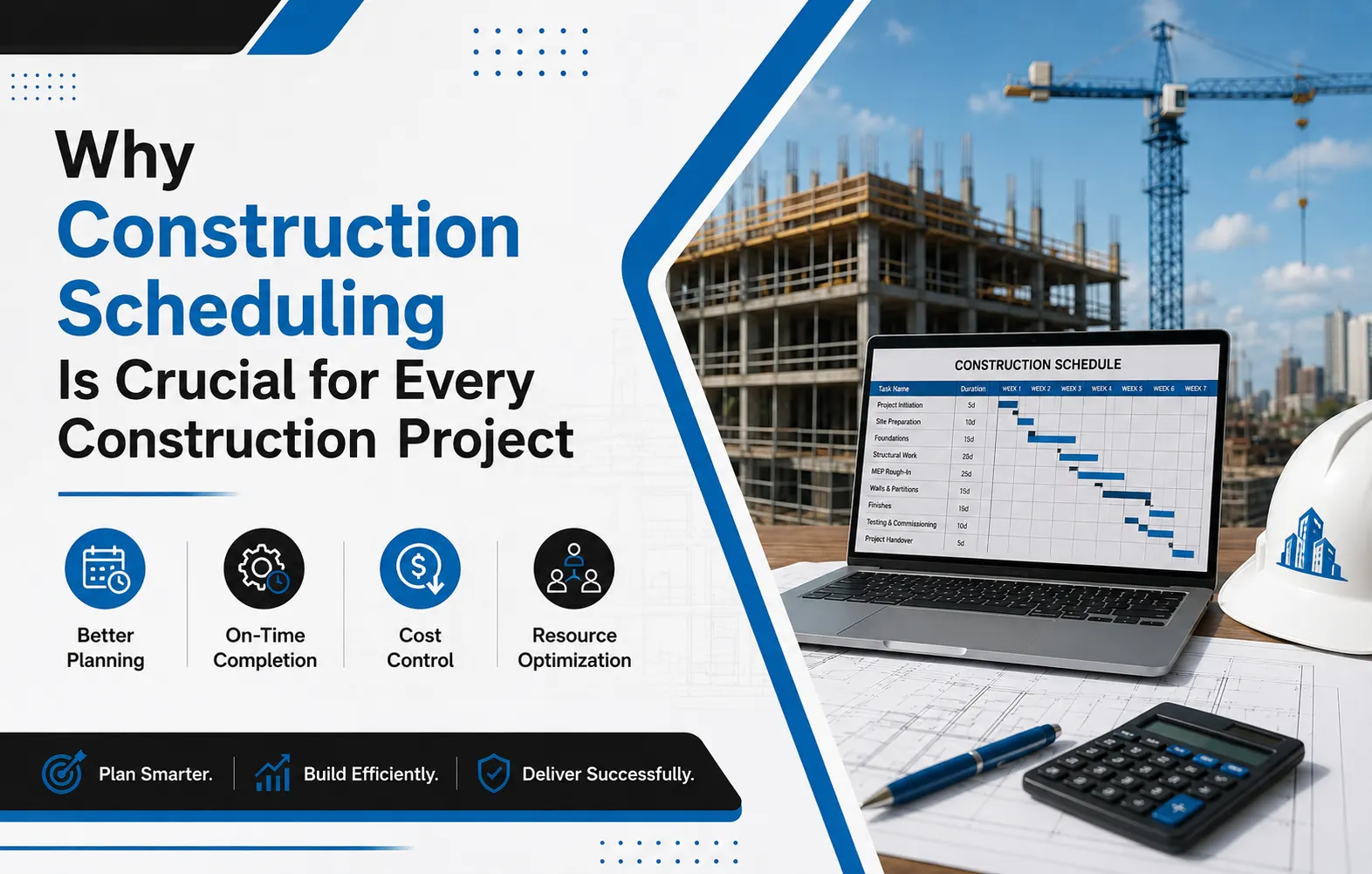
Why Construction Scheduling Is Crucial for Every Construction Project?

Every successful construction project starts with a plan and a schedule. This schedule is like a map that shows what needs to be done when it needs to be done and who will do it. It helps contractors finish projects on time and stay within their budget. Whether you are building a house, a store or a factory a good schedule is very important. It helps contractors avoid problems and save money. When you combine a schedule with a good estimate of the costs you can be sure that your project will be a success.

What Is Construction Scheduling?

Construction scheduling is like a roadmap for your project. It shows every step of the way from planning to finishing. It helps you know what needs to be done when it needs to be done and who will do it. A good schedule helps project managers keep track of progress and fix problems before they become issues.

Controlling Your Budget with Good Estimates

Scheduling and budgeting go together. If you do not have an estimate of your costs your schedule will not work. Professional estimators can help you figure out how much things will cost estimation, including labor, materials and equipment. This helps you allocate your budget wisely and make sure you have money for every step of the project.

When you have an estimate and a good schedule you can avoid wasting money and stay within your budget. This helps you make a profit and finish your project successfully.

Managing Your Resources Well

Construction projects involve people, teams and equipment. A good schedule helps you make sure that everyone and everything is in the place at the right time. This reduces wasted time avoids conflicts and keeps materials coming on schedule.

Professional estimators can also help you figure out how material you need so you do not run out or buy too much.

Avoiding Delays and Risks

Delays can happen in construction because of weather, supply chain problems or labor shortages. A good schedule helps you identify problems and come up with a plan to avoid them. Regular updates help everyone involved in the project stay informed and on track.

The Importance of MEP Coordination

buildings need careful planning for mechanical, electrical and plumbing systems. Professional estimators can help you calculate the costs and materials needed for these systems. This helps you avoid mistakes and delays.

Supporting Big Construction Projects

Big construction companies in Sydney manage projects at the same time. Good scheduling helps them coordinate teams monitor progress and stay productive. When you combine estimating expertise with good scheduling you can ensure that your project meets local standards stays within budget and finishes on time.

Why Choose Construction Estimate Help?

Construction Estimate Help provides estimating services for residential, commercial and industrial projects. Their experienced estimators deliver cost analyses that help you plan smarter make better decisions and finish your project successfully. By working with Construction Estimate Help you can plan efficiently control your budget and finish your project on time.

Construction scheduling is not about making a timeline. It is the foundation of successful project management. When you combine scheduling with accurate estimating services you can reduce risks improve productivity and finish your project on time and within budget. Whether you are working on a local project or a big construction project in Sydney investing in professional planning is essential for long-term success.

Frequently Asked Questions (FAQs)

1. Why is construction scheduling important?

Construction scheduling helps you organize your project manage resources efficiently avoid delays and finish your project on time and within budget.

2. How do construction estimating services support scheduling?

Construction estimating services provide cost and material estimates that help you create a realistic schedule and allocate resources effectively.

3. What are MEP Estimating Services?

MEP Estimating Services calculate the costs and materials needed for electrical and plumbing systems helping you avoid installation conflicts and budget overruns.

4. What are Cost Estimating Services?

Cost Estimating Services provide projections for labor, materials, equipment and overhead expenses before construction begins, improving your financial planning.

5. Why should construction companies in Sydney use estimating services?

Professional estimating services help construction companies, in Sydney prepare bids manage budgets comply with local standards and finish projects more efficiently.

What Is LOD in Construction and How Does It Work in BIM?

The Level of Development is one of the important ideas in Building Information Modeling. It tells us how much detail and accuracy a Building Information Modeling model contains at stages of a construction project. By setting expectations for design and construction teams the Level of Development helps improve communication minimize errors and support better decision-making. When combined with construction estimating services the Level of Development enables contractors and project owners to create accurate budgets, schedules and material takeoffs from the earliest planning stages.

Understanding the Level of Development in Building Information Modeling

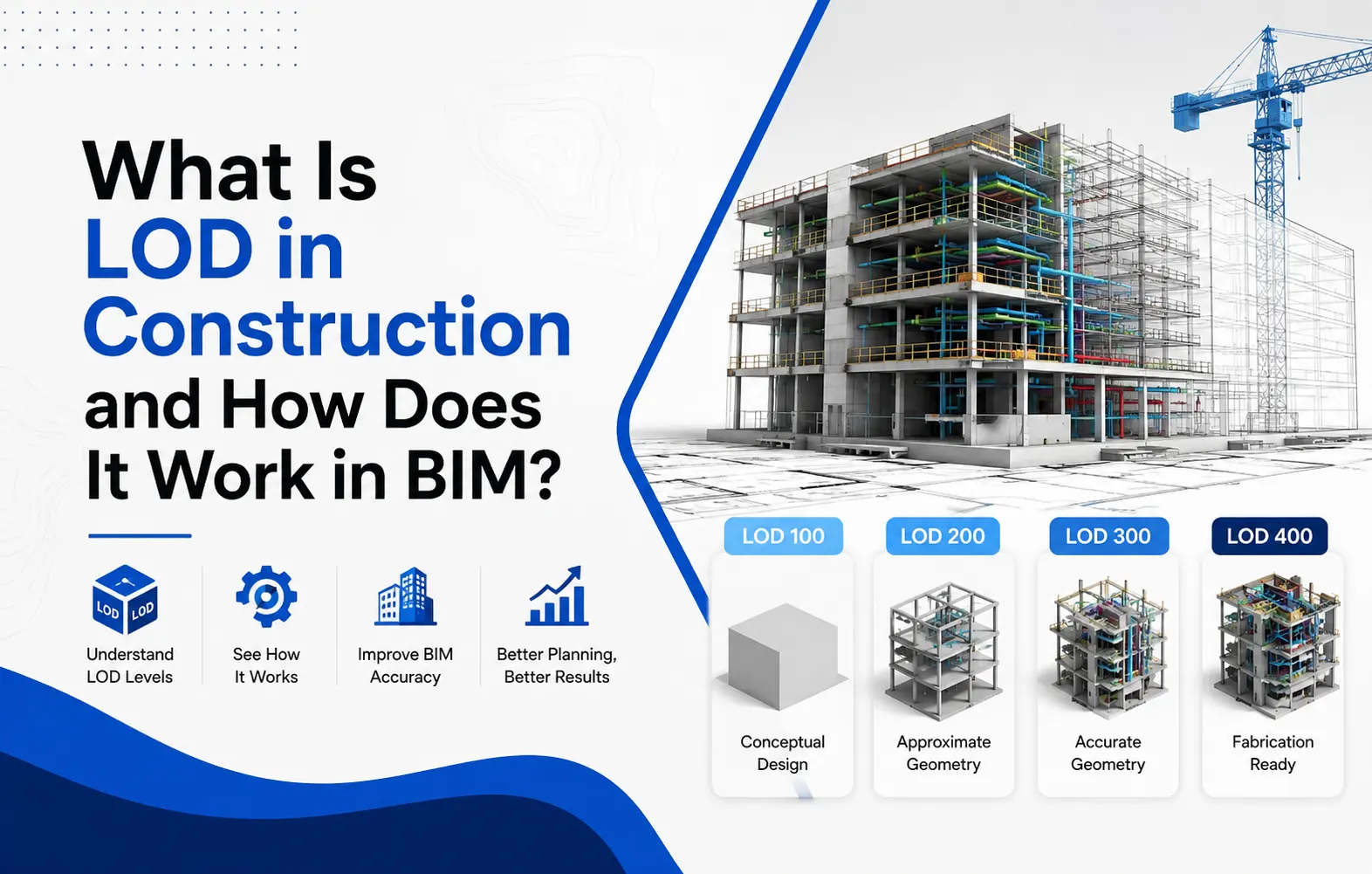
The Level of Development stands for a system used to describe the completeness of Building Information Modeling elements. As a project progresses the model evolves from conceptual designs to detailed construction-ready information.

The Level of Development levels include:

  • Level of Development 100: Conceptual design with basic shapes and approximate information.
  • Level of Development 200: General geometry and estimated quantities are included.
  • Level of Development 300: dimensions and locations suitable for coordination and estimating.
  • Level of Development 350: Additional details showing how building components interact.
  • Level of Development 400: Fabrication-level information used for manufacturing and installation.
  • Level of Development 500: As-built model representing the completed project for facility management.

Each level provides increasing detail allowing project teams to make decisions throughout the construction lifecycle.

How the Level of Development Works in Building Information Modeling

Building Information Modeling uses the Level of Development standards to ensure every stakeholder understands what information is available at each stage. Architects, engineers, contractors and owners collaborate using a shared model reducing misunderstandings and improving project coordination.

As the Level of Development increases project teams can generate accurate material quantities, schedules and cost estimates. This is where reliable construction estimating services become especially valuable. Estimators use Building Information Modeling models with Level of Development to prepare detailed cost analyses helping clients avoid budget overruns and unexpected expenses.

Benefits of the Level of Development in Construction

Using the Level of Development within Building Information Modeling offers numerous advantages, including:

  • Improved communication among project stakeholders.
  • Accurate quantity takeoffs and material estimates.
  • Reduced design conflicts through clash detection.
  • Better project. Scheduling.
  • Lower construction. Fewer costly changes.
  • Enhanced quality control throughout the project.

Professional construction estimating services providers in Brisbane often rely on Building Information Modeling models to produce dependable cost estimates for residential, commercial and industrial developments.

The Level of Development and Construction Estimating

Accurate estimating depends on the quality of project information. With Building Information Modeling models estimators can calculate labor, materials, equipment and project timelines with greater confidence.

Professional construction estimating services help contractors:

  • Prepare bids.
  • Control project costs.
  • Improve accuracy.
  • Reduce material waste.
  • Increase profitability.

Many contractors also use construction bidding websites to identify project opportunities. Accurate estimates based on Building Information Modeling and the Level of Development allow businesses to submit proposals with confidence and improve their chances of winning contracts.

The Importance of Site Work Estimating

Before vertical construction begins site preparation is essential. Site Work Estimating Services help calculate excavation, grading, drainage, utilities, paving and other earthwork costs. When supported by Building Information Modeling models with Level of Development these estimates become significantly more accurate reducing financial risks during the early phases of construction.

Why Choose Construction Estimate Help?

Construction Estimate Help provides estimating solutions for contractors, developers, architects and engineers. From budgeting to detailed quantity takeoffs the team uses advanced estimating practices and Building Information Modeling-based workflows to deliver accurate results. Whether you require construction estimating services in Brisbane, Site Work Estimating Services or support for projects sourced through construction bidding websites Construction Estimate Help helps you plan with confidence.

The Level of Development is a component of Building Information Modeling that ensures construction models become progressively more detailed as projects move forward. When paired with expert construction estimating services the Level of Development improves budgeting, project coordination and decision-making. Investing in Building Information Modeling-based estimating helps reduce risks increase efficiency and achieve construction outcomes from planning through project completion.

Frequently Asked Questions

1. What does the Level of Development mean in construction?

The Level of Development stands for the amount of detail and reliability included in a Building Information Modeling model during project stages.

2. Why is the Level of Development important, in Building Information Modeling?

The Level of Development improves collaboration supports cost estimation reduces design conflicts and ensures every stakeholder understands the level of information available.

3. How do construction estimating services benefit from Building Information Modeling?

Professional construction estimating services use Building Information Modeling models to generate quantity takeoffs, material lists, labor estimates and project budgets.

4. What are construction bidding websites?

Construction bidding websites are online platforms where contractors can find construction projects and submit competitive bids.

5. What do Site Work Estimating Services include?

Site Work Estimating Services typically cover excavation, grading, earthwork, drainage systems, utility installation, paving, landscaping and other site preparation costs before construction begins.

Bid Analysis: Meaning, Process, Types, and Evaluation Criteria

As you know, we work within a competitive procurement and construction industry where Bid Analysis is one of the vital functions to select a suitable contractor, supplier or service provider. Regardless of what the specific field of working might be, such as Virtual Bid Management, construction estimating and bidding, procurement activities and others, the more informed we are about bid analysis, the more effective are our decisions, lower the cost and higher the project success.

Meaning of Bid Analysis

The definition of Bid Analysis is “the process of evaluating submitted proposals from vendors, contractors or suppliers to an open tender or RFP (Request for Proposal).” We must remember here that “best” value is not just the lowest price, but best value including consideration for cost, quality, capability, conformance and other project constraints and specifications.

In the case of Bid analysis in procurement, multiple factors should be analyzed for achieving efficiency in the expenditure and optimum resource allocation. The purpose of this is to avoid misleading evaluations.

How Does Bid Analysis Work?

Many people often ask “how does bid analysis work”. Generally, bid analysis involves receiving all proposals, reading the content and comparing different factors such as price structures, experience, qualifications of the bidder and others and finally selecting a suitable one based on multiple constraints and aspects.

It is important that a properly Structured Procurement bid assessment is performed. In other words, the process must be done systematically to make sure that one doesn’t make any faulty decision and to prevent the procurement risks arising from low qualified contractors. Accurate Construction estimating services are an essential component in the process to evaluate and compare submitted construction bids.

Bid Analysis Process

Here is the generally adopted Bid analysis process:

1. Bid Collection

All bids submitted are collected and systematically organized by the requirements specified in the tender.

2. Preliminary Screening

The irrelevant and invalid bids (late submissions, insufficient requirements, etc.) are rejected.

3. Technical Evaluation

Experience, expertise, capability and quality of the submitted proposal along with any methodology is assessed and evaluated.

4. Commercial Evaluation

Pricing structure, payment terms and finances of the submitted bid are reviewed.

5. Comparative Analysis

Comparison between all submitted bids to assess and analyze the strengths and weaknesses of each one.

6. Final Selection

A choice is made between all proposed bids based on best value, meeting project requirements etc.
Companies like Construction Estimate Help provide support to clients for Bid analysis.

Types of Bid Analysis

There are different types of bid analysis in a process and we need to decide which one is most appropriate for us.

  • Cost-Based Analysis- focuses on price
  • Technical Analysis- evaluates technical capability of a proposal
  • Financial Analysis- assesses financial strength and stability of the bid
  • Risk-Based Analysis- looks at risks in the delivery of a project
  • Value-Based Analysis- compares and contrasts multiple bids on a variety of criteria to assess overall value.

These are generally used in Tender bid analysis.

Bid Evaluation Criteria

When making the decision of evaluating proposals based on multiple aspects of a proposal; a specific set of Bid evaluation criteria is normally defined and followed. These could be:

  • Competitive pricing
  • Technical competence
  • Experience and past performance
  • Quality assurance procedures
  • Delivery schedule
  • Compliance to requirements
  • Financial stability
  • Safety record
  • Client references
  • Post-award service.

The selection of vendor through the process of Vendor bid evaluation.

Importance of Bid Analysis in Construction

Bid analysis is paramount for any construction project. As you might know, construction estimating and bidding is extremely important for all construction owners and contractors, whether or not using virtual bid management systems. This helps the owner to make informed decisions of who is the most suitable contractor, also providing them with valuable information as to whether a submitted construction bid is reasonable and cost-effective. Professional services, such as those of Construction Estimate Help, help clients by estimating construction costs, comparing sub-bids, and generally guiding them throughout the process.

Conclusion

Bid Analysis is undoubtedly a critical process in procurement and construction. Understanding its meaning, definition, various types and adopting appropriate bid evaluation criteria ensures optimum results are achieved at minimum cost while maintaining quality of the project. Bid Analysis whether through Virtual Bid Management solutions or simply conducting a Vendor bid evaluation will always serve in guiding the decision making process to ensure best project outcomes.

Frequently Asked Questions (FAQs)

What is bid analysis?

Bid analysis is the method of evaluating proposals submitted from different vendors, contractors, or suppliers to identify the best proposal for a project.

Why is bid analysis important in procurement?

Bid analysis in procurement leads to transparent, efficient and cost-effective procurement and expenditure.

What are the main types of bid analysis?

These types include the Cost-Based Analysis, Technical Analysis, Financial Analysis, Risk-Based Analysis and Value-Based Analysis.

How does bid analysis work in construction?

In construction, bid analysis compares contractor proposals with each other to determine the most appropriate contractor for the project based on various criteria such as cost, quality, and experience.

How can Construction Estimate Help assist with bid analysis?

Construction Estimate Help can help with construction estimating and bidding through various services that include construction estimating, bid reviews, cost analysis and more.